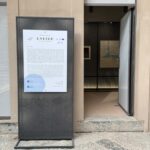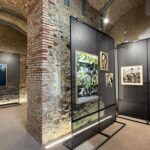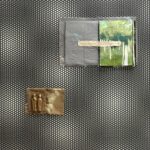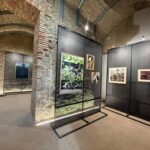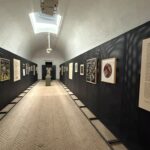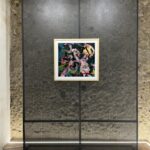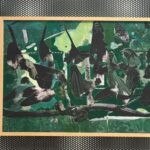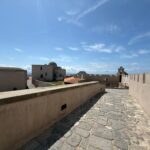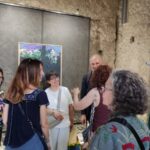
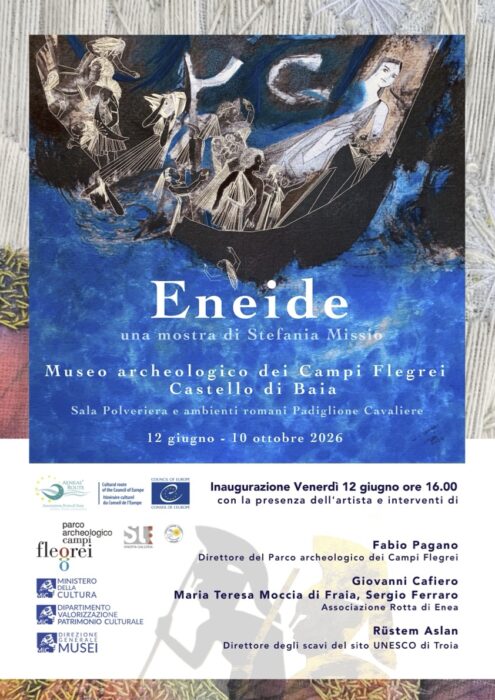
Aeneid is the title of the exhibition, inspired by Virgil’s poem, bringing together 36 works by artist Stefania Misso. The Association Rotta di Enea — a Cultural Route of the Council of Europe since 2021 — in agreement with the Archaeological Park, chose to develop it into a project for the Campi Flegrei. The inauguration, on 12 June 2026, will be attended by the Roman-born artist who has lived and worked in Sardinia for many years, along with addresses by Fabio Pagano, Director of the Archaeological Park of the Phlegraean Fields, and by Giovanni Cafiero and Maria Teresa Moccia di Fraia on behalf of the Association Rotta di Enea.
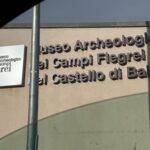
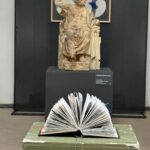
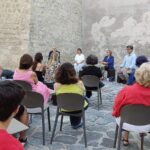
The project, curated by the Association Rotta di Enea, includes the exhibition at the Archaeological Museum of the Campi Flegrei in the Castle of Baia, as well as creative workshops with classes from the Istituto Statale Virgilio in Pozzuoli. Students were invited to create new sibylline signs under the expert guidance of the artist and the teaching staff of the Istituto Virgilio; these are displayed in the exhibition in the form of artist’s books.
Community participation is the cornerstone of the “Aeneid” Project, inspired by the principles of the Council of Europe Framework Convention on the Value of Cultural Heritage for Society (COUNCIL OF EUROPE – FARO, 27.X.2005), ratified by Italy under Law no. 133/2020. The Faro Convention shifts the focus from the cultural asset itself to its value for people and communities. It promotes democratic participation, human rights and sustainable development, and regards heritage as a resource for quality of life.
The Trojan hero — an exile following the destruction of Troy — stands as a timeless symbol of wandering the world in search of new shores. But never alone, and never solely for oneself. Aeneas carries tradition on his shoulders (Anchises) and holds the future by the hand (Ascanius). Around Aeneas flourish stories and characters — not only Dido, but Palinurus, Euryalus and Nisus, and many others.
The threads that, through Stefania Missio’s careful artistic hands, clothe the characters of the Aeneid are an authentic expression of that pietas and humanity which define Virgil’s work. To these feelings and values we must still cling today, against the drift toward violence and oppression that international events in Ukraine and the Middle East so sadly bring to mind.
“The patient work of Stefania Missio, so full of humanity and love for our Mediterranean civilisation,” declares Rotta di Enea president Giovanni Cafiero, “perfectly reflects the values that inspire the Rotta di Enea and finds its ideal home in the Campi Flegrei, the setting of the events narrated in Book VI of the Aeneid. Across Europe, the Mediterranean and the world, three thousand years after the Trojan War, there are still refugees, still vengeance, still attempts to impose the law of force. The Aeneid and our Virgil remain a living point of reference, reminding us that the progress of human civilisation springs from empathy, from the ability to cooperate, from the strength of values, and from patience.”
“We still need Aeneas and his story,” concludes the Director of the Archaeological Park, Fabio Pagano. “We still need to tell it, to wear it, to question it, to see ourselves reflected in it. Stefania Missio offers us a ‘weave of weaves’ in which to lead our soul through a world peopled with images of archaic flavour clothed in contemporary forms — a transfiguration in which the ancient reshapes itself, accompanying Aeneas into the dimension most truly his own: that of the universal.”